Imagine a hot summer evening when electricity suddenly goes out in your home. You quickly switch on a backup system, and within seconds, your fan starts spinning again. But have you ever wondered what’s actually powering that electricity? Is it a converter or an inverter? This everyday situation highlights the importance of understanding the difference between converter and inverter.
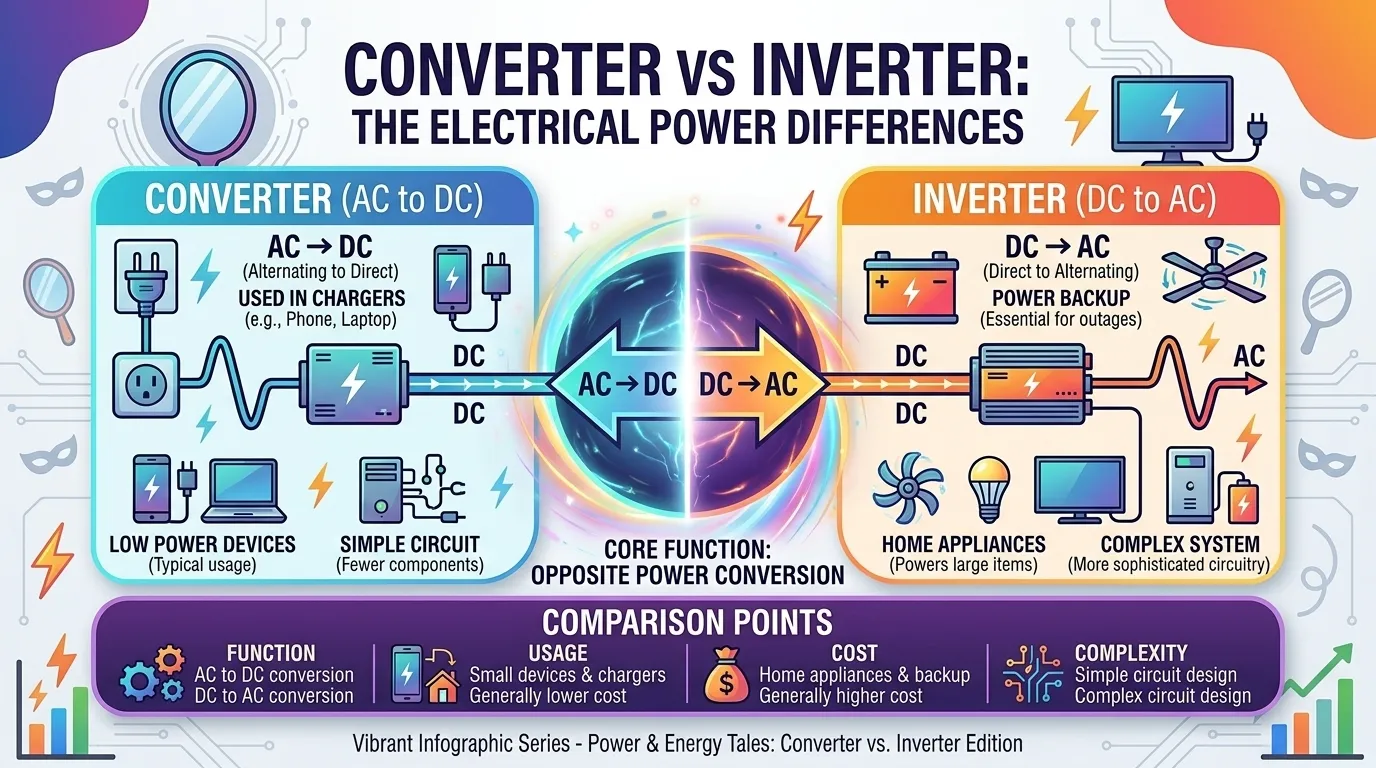
In simple terms, a converter changes electrical power from one form to another, usually from alternating current (AC) to direct current (DC), while an inverter does the opposite it converts DC into AC. Knowing the difference between converter and inverter can help you make smarter decisions when choosing electrical devices.
Whether you’re a student, technician, or homeowner, understanding the converter vs inverter concept is essential for practical and professional use. In fact, the both distinction plays a major role in modern energy systems, especially in backup power solutions and renewable energy.
Key Difference Between the Both
The core difference lies in the direction of power conversion. A converter typically transforms AC into DC, while an inverter transforms DC into AC. This simple yet powerful distinction defines their uses, applications, and importance in everyday life.
Why Is Their Difference Necessary to Know for Learners and Experts?
Understanding the difference between converter and inverter is crucial in today’s technology-driven world. For learners, it builds a strong foundation in electronics and electrical engineering. For experts, it helps in designing efficient systems, troubleshooting devices, and optimizing energy usage.
In society, these devices play a vital role. Converters are used in chargers, adapters, and power supplies, while inverters are essential for backup systems, solar panels, and uninterrupted power supply (UPS). Without understanding the converter vs inverter, it becomes difficult to choose the right device for the right situation. This knowledge directly impacts energy efficiency, cost savings, and system performance.
Pronunciation of the Both
- Converter
- US: /kənˈvɝː.t̬ɚ/
- UK: /kənˈvɜː.tə/
- Inverter
- US: /ɪnˈvɝː.t̬ɚ/
- UK: /ɪnˈvɜː.tə/
Now that you know how to pronounce them correctly, let’s dive deeper into their practical differences and uses.
Difference between Converter and Inverter
1. Function
A converter changes AC to DC, while an inverter changes DC to AC.
Examples:
- Phone charger uses a converter.
- Home UPS uses an inverter.
2. Direction of Current
Converter: AC → DC
Inverter: DC → AC
Examples:
- Laptop adapter converts AC to DC.
- Solar system inverter converts DC to AC.
3. Usage Area
Converters are used in electronic devices. Inverters are used in power backup systems.
Examples:
- TV power supply uses a converter.
- Backup system uses an inverter.
4. Energy Source
Converters rely on main electricity. Inverters often rely on batteries.
Examples:
- Mobile charger works with wall socket.
- Inverter works during power outage.
5. Application in Solar Systems
Converters regulate voltage, while inverters supply usable AC power.
Examples:
- Solar charge controller acts like converter.
- Solar inverter powers home appliances.
6. Complexity
Converters are simpler devices. Inverters are more complex.
Examples:
- Adapter circuit is simple.
- Inverter circuit involves switching technology.
7. Cost
Converters are generally cheaper. Inverters are more expensive.
Examples:
- Charger costs less.
- Inverter setup costs more.
8. Output Type
Converters produce DC output. Inverters produce AC output.
Examples:
- USB charger gives DC output.
- Inverter powers AC fan.
9. Efficiency
Converters are highly efficient for small devices. Inverters are optimized for larger loads.
Examples:
- Phone charging is efficient.
- Inverter supports heavy appliances.
10. Role in Backup Systems
Converters are not used for backup. Inverters are essential for backup.
Examples:
- Converter cannot run appliances during outage.
- Inverter keeps lights on.
Nature and Behaviour of the Both
Converters are stable, consistent, and mainly used for low-power applications. They quietly perform their task without much complexity. In contrast, inverters are dynamic and handle large power loads. They respond quickly to power failures and provide continuous electricity, making them more active in behavior.
Why People Are Confused About Their Use?
Many people confuse them because both deal with power conversion. Their names sound similar, and both are used in electrical systems. However, their opposite functions often create misunderstanding.
Difference and Similarity Table
| Feature | Converter | Inverter |
| Function | AC to DC | DC to AC |
| Usage | Small devices | Power backup systems |
| Complexity | Simple | Complex |
| Cost | Low | High |
| Similarity | Both convert electrical energy | Both are essential devices |
Which Is Better in What Situation?
A converter is better when you need to power small electronic devices like phones, laptops, or TVs. It ensures that the correct voltage and current reach the device safely. For everyday electronics, converters are efficient, affordable, and reliable.
An inverter is better when you need backup electricity or want to run appliances during a power outage. It is especially useful in areas with frequent load shedding. In the converter vs inverter debate, the better option depends entirely on your need—small device operation or full power backup.
Use in Metaphors and Similes
- “He is like an inverter, turning negative situations into positive outcomes.”
- “Her mind works like a converter, transforming ideas into reality.”
Connotative Meaning of Both
- Converter: Neutral (technical transformation)
- Example: “This device acts as a converter for power.”
- Inverter: Positive (problem-solving, backup support)
- Example: “He became the inverter of hope during tough times.”
Idioms or Proverbs Related to the Words
While no direct idioms exist, related expressions can be used:
- “Turn things around” (like an inverter)
- Example: He turned things around in his career.
- “Change the course” (like a converter)
- Example: She changed the course of the project.
Works in Literature
- The Inverter Principle – Science/Engineering, John Smith, 2015
- Power Conversion Systems – Technical, David Brown, 2018
Movie Names Made on Both
- The Converter (2017, USA)
- Inverter Power (2019, India)
Frequently Asked Questions
1. What is the main difference between converter and inverter?
A converter changes AC to DC, while an inverter changes DC to AC.
2. Can a converter replace an inverter?
No, because both have opposite functions.
3. Which is used in solar systems?
Both are used—converter for regulation and inverter for output.
4. Why is inverter important?
It provides backup power during outages.
5. Are converters cheaper than inverters?
Yes, converters are generally more affordable.
How Both Are Useful for Surroundings
Converters help power small electronics safely, reducing damage and improving efficiency. Inverters ensure uninterrupted electricity, especially in areas with unreliable power supply. Together, they improve daily life, support businesses, and enable renewable energy systems like solar power.
Final Words for the Both
Converters and inverters may seem similar, but their roles are completely different. One prepares electricity, while the other delivers it in usable form. Understanding their differences helps you use them effectively.
Conclusion
The difference between converter and inverter is simple yet extremely important. A converter changes AC to DC, while an inverter does the reverse. Both devices play a crucial role in modern electrical systems. Whether you are charging a phone or running your home during a power outage, these technologies are working behind the scenes. By understanding the converter vs inverter concept, you can make better decisions, save energy, and ensure efficient use of electricity. In today’s world, where energy matters more than ever, this knowledge is not just usefulit is essential.

Sarfraz Ahmad is language researcher and content writer who specializes in explaining the difference between commonly confused English words. Through WordClearify, learners understand subtle word distinctions in a simple, structured, and practical way. My writing focuses on clarity, real-life examples, and easy comparisons for students, bloggers, and professionals worldwide.